Make the reasoning accountable.
Clinical Reasoning Desk (CRD) is a clinician-controlled environment for connecting evidence, working formulations, repeated measures and decisions over time. AI is supporting context—not the clinical decision maker.
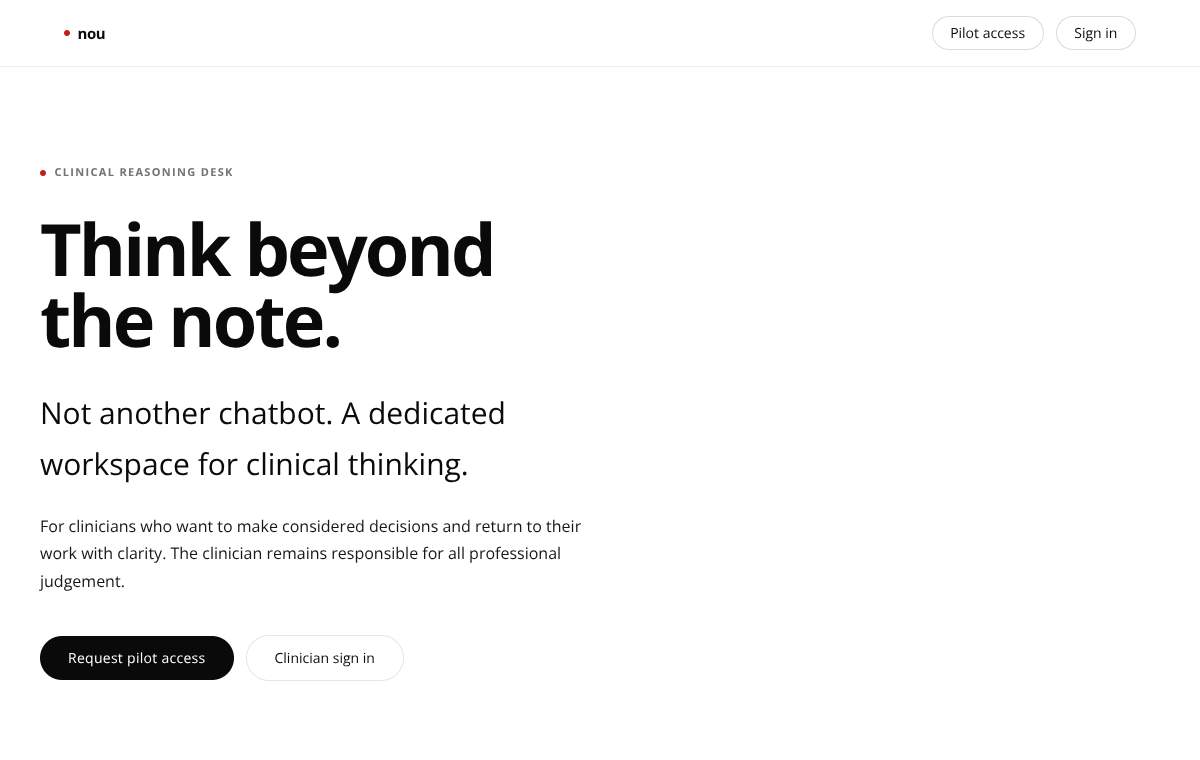
Clinical decisions should be reconstructable.
Longitudinal cases involve changing evidence, competing explanations, measurement history and revision over time. Summaries alone can lose uncertainty, obscure origin, and confuse a clinician’s owned formulation with an AI suggestion. CRD treats reasoning state as a product requirement—not a decorative AI summary.
Traceability built into clinical workflows.
- Preserve authorship. Human, AI and clinician-edited AI formulations carry distinct provenance, even after clinician ownership or reload.
- Protect measurement integrity. PHQ-9/GAD-7 totals are recalculated on the server; raw item responses remain authoritative. PHQ-9 item 9 remains visible independently of total severity without auto-diagnosis.
- Reject silent overwrites. Revision-aware saves fail closed on stale case state, preserving the draft for explicit resolution.
- Make exports consistent. Preview and downloaded document draw on a shared frozen evidence snapshot, including context and timestamp.
- Bound AI by persisted evidence. Draft generation gates check cited excerpts and canonical source references against server-held case state; full semantic correctness is not inferred from quote matching.
Implemented engineering, with explicit release gates.
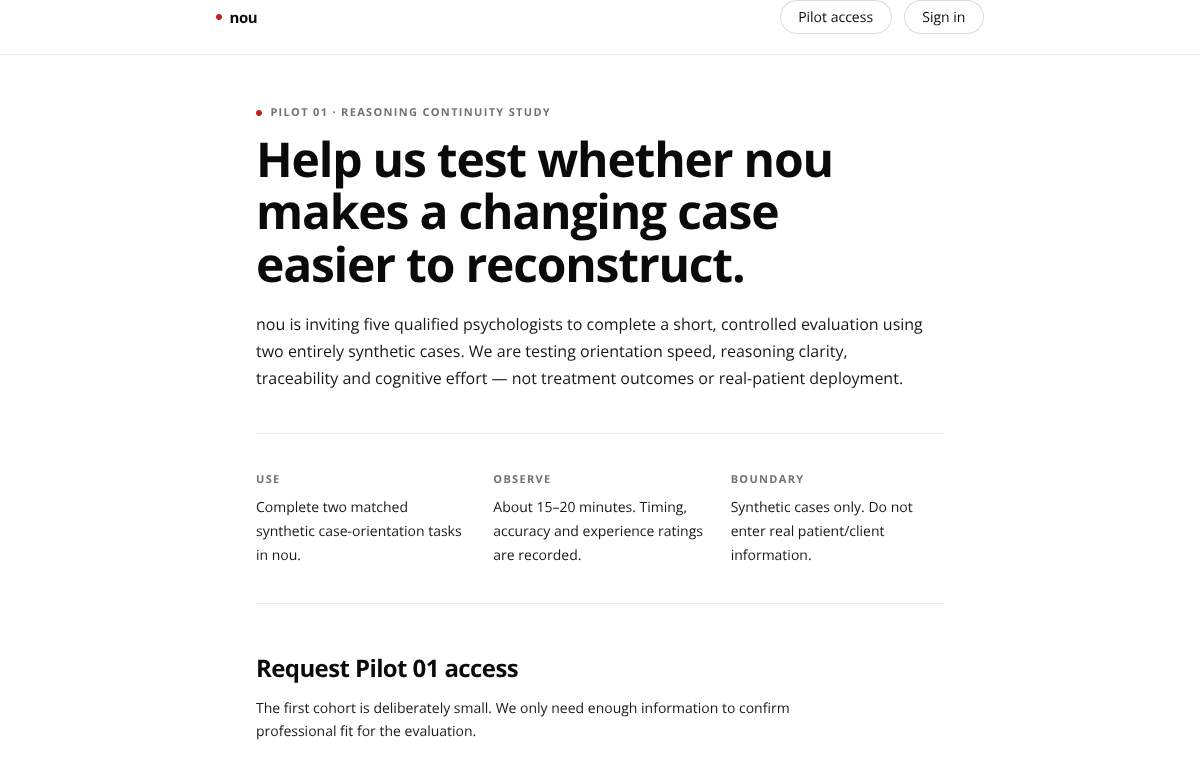
Documented basis: merged Truth Kernel implementation, October 2026; isolated pilot candidate testing; current public captures. Two further PRs remain open and are not represented as released improvements.
Founder-level product direction.
My responsibilities include the product proposition, clinician workflow, requirements, feature prioritisation, evaluation and release criteria. I direct AI-assisted technical implementation and evidence review. This is product and systems leadership; the case study does not claim every line of code was personally authored.
Clinical deployment remains a no-go.
Exact-head CI, authenticated end-to-end synthetic workflows, conflict recovery, qualified independent clinical review, information-governance approval and a controlled pilot must be independently verified. No patient outcomes, clinician adoption, commercial revenue or TRL 5–6 certification is claimed.
Evidence boundary
Only public CRD screens are shown. No patient information, authentication details, unpublished prompts or private repository contents are exposed. Continue to the PSYTECH News case study.